
Phase 2 Report:Gender-Based Violence
The Muslim Advisory Council of Canada (MACC), in collaboration with the Centre for Community-Based Research (CCBR), present the Year 2 Research Report, which is part of a 3-year research project titled, Researching Barriers to Gender-Based Violence (GBV) Services for Canadian Muslims Through Community-Driven Knowledge Mobilization.
Phase 2 Report Shows What Works and What Must Change to Support Muslim Women Experiencing Gender-Based Violence
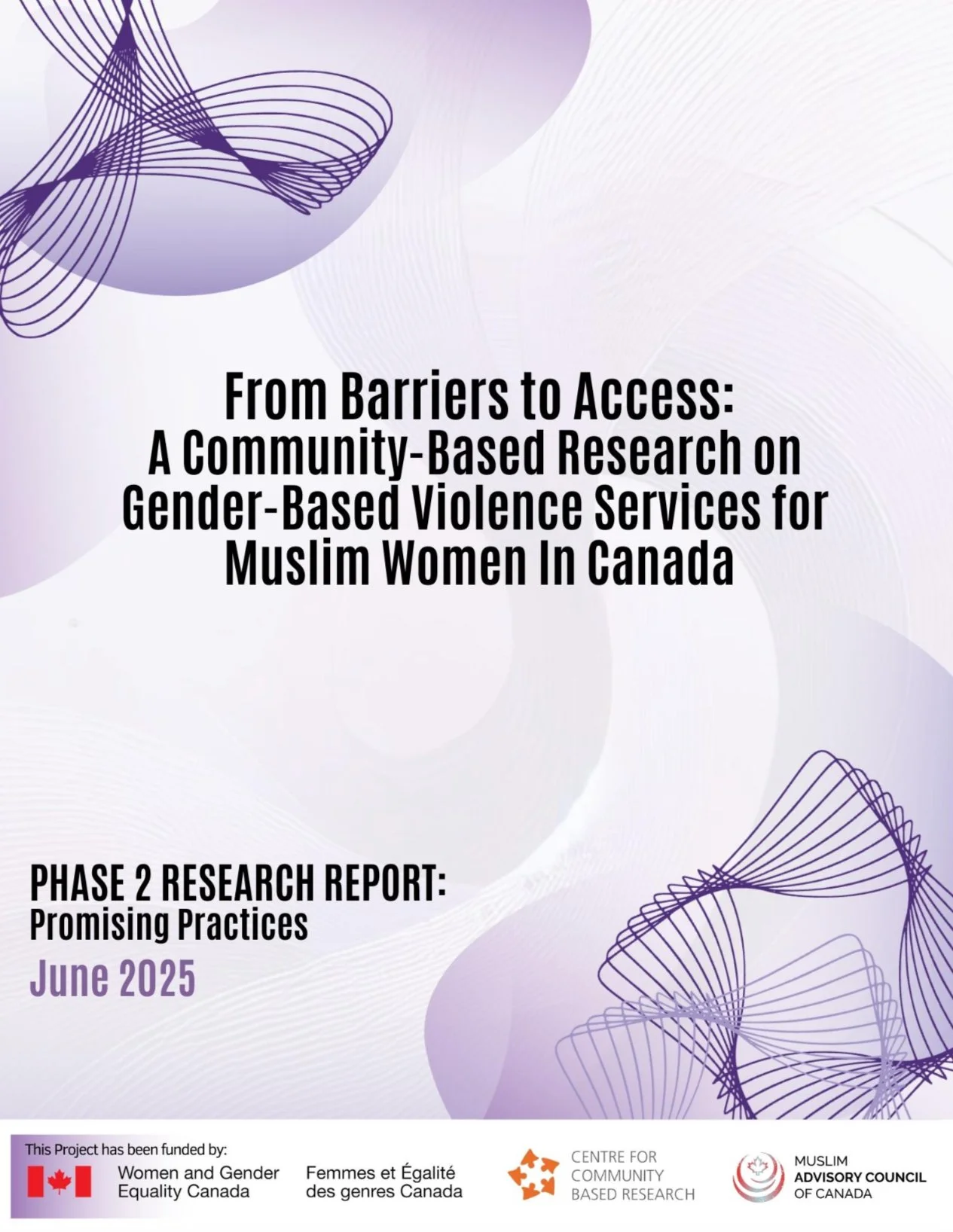
Building on Phase 1 findings the Phase 2 Report (1) presents promising practices and (2) provides actionable practical and policy-level recommendations to improve GBV services for Muslim women at local and systemic levels in Halton Region and beyond.
Key Findings:
1. Identified Promising Practices:
* The following promising practices are crucial in ensuring care is informed, impactful and long-lasting. These practices, along with strong referral networks, and cross-organizational partnerships are pivotal in providing comprehensive support, expanding access, building trust, and connecting clients with timely and relevant support, which ultimately enhance the experiences of Muslim women receiving support for GBV.
Tailored client-centered approaches
Comprehensive culturally and linguistically responsive care
Trauma Informed Practices
Offering Flexible service models
Working towards clients’ independence
Ongoing capacity building for staff and teams
2. Actionable Recommendations
Local Level Recommendations (aim to embed best practices across sectors):
Designing faith and religion-sensitive programs
Invest in staff training on cultural competency and intersectionality
Develop smoother transitions from shelter life to full independence,
Ongoing connection and follow-up after formal services end
Develop partnerships with culturally oriented organizations
Collaborative cross-organizational learning and advocacy to strengthen service coordination and delivery.
Societal and Systemic Recommendations:
Practice-Level Recommendations
meaningful integration of Muslim-led and culturally informed organizations into mainstream systems of care and decision making
trauma-informed and culturally competent training for public service providers
multilingual outreach and service delivery beyond basic translation
Policy-Level Recommendations
National investment in inclusive policy reforms that explicitly address systemic racism and Islamophobia, barriers in child welfare, immigration, and housing sectors.
Provide sustained funding for Muslim-centered services
Expand eligibility for support to include non-status survivors
Reduce bureaucratic barriers that currently prevent Muslim women from receiving help after abuse
OVERALL Recommendations:
Foster cross-sector collaboration among service providers
Build access points through trusted organizations
Scale-up culturally responsive models (models identified as best practices and expanding them across mainstream organizations and provinces to reach underserved populations such as Muslim women)
By detailing concrete ways to reduce stigma, improve service delivery, and help Muslim women feel safe and confident in reporting GBV and seeking help, the identified promising practices and actionable recommendations in the Phase 2 Report aligns with core pillars of prevention, support, access to justice, and systemic transformation and directly offers strategic recommendations aligned with Canada's National Action Plan to End Gender-Based Violence. Phase 2 calls on policymakers, funders, service providers, and community leaders to build an intersectional, inclusive ecosystem of care where Muslim women can seek help with safety, dignity and confidence.
Next Steps
The next and final phase of this research project focuses on knowledge sharing and building community capacity. Drawing from findings and recommendations in Phases 1 and 2, the project team is developing sharable knowledge products and training tools to embed the lessons of this research into sustainable, practical tools and improve practices that support Muslim women survivors of GBV.
Join the Conversation
The Muslim Advisory Council of Canada invites community members, service providers, and advocates to engage with this critical work. By addressing the unique challenges faced by Muslim women, we can collectively create a safer, more inclusive society for all.
To access the full report or learn how to support this initiative, visit https://www.muslimadvisory.ca/researching-barriers-to-gender-based-violence-services-for-canadian-muslims